Séverin Naudet
After Vanity Fair published my portrait, I wanted to tell the story behind this passion. A story about style, of course, but also about family, freedom and memory.
Read the portrait in Vanity Fair
A family home
For years, my peculiar, passionate “obsession” with Ralph Lauren, the Bronx-born son of a Jewish family from Pinsk, was met with fond, gently mocking smiles. My friends never tired of teasing me about my yellow, green, pink and blue patchwork in summer, my Scottish tartans in winter.
It seems I have been a Lo Head for twenty years. Lo Heads are Polo Ralph Lauren devotees: collectors, amiable obsessives, connoisseurs who can identify a line, an era, a rare piece or a collection anywhere, from a distance. What fascinates me, in truth, is the extraordinary entrepreneur himself, a creative talent in a class of his own: a dreamer, a storyteller, a creator of worlds, a salesman, a marketing genius.
As a teenager, I tried to disappear into my clothes. I was uncomfortable in my own skin, and not only in a physical sense.
My father, whom I barely knew, had left me with just two images: a gold-buttoned blazer over grey flannel trousers, elegant but too conventional, and a slightly faded yellow Lacoste polo shirt. Beyond that, I had no model, no point of reference. In everyday life, there was nothing distinctive about my appearance, no colour; I cultivated a camouflage that was almost invariably black. Later, in my twenties, working for an international music producer and with numerous American rappers, I adopted the uniform of street chic to fit in: Stüssy, worn loose enough to hide my bowed legs.
For years, I searched for a pair of jeans I could wear without feeling self-conscious. Once my streetwear phase was behind me, I walked into Ralph Lauren one day, or, more precisely, into RRL, its workwear world of the American West. I tried on a pair of Low Straights. Ever since, I have bought at least two pairs a year, to make sure I have enough to last me a lifetime. I had just discovered the magic of RL.
A Ralph Lauren boutique is not simply a shop. I had walked into the family home I had never had. I wandered through a sitting room of worn leather, a library with a fire burning in the hearth; I imagined the dog asleep on the rug at the foot of the stairs. A Ralph Lauren flagship is a country house, the promise of a weekend by the sea, a New York apartment for a perfect Christmas, perhaps a Parisian hotel for a family lunch.
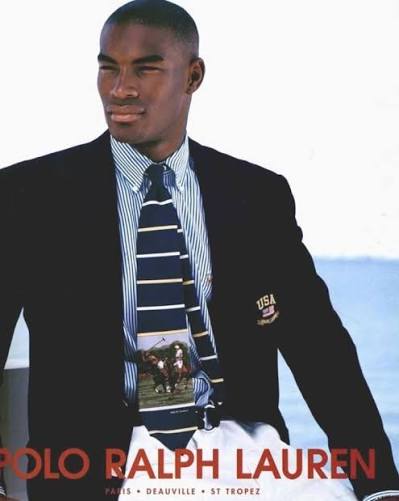
Polo Ralph Lauren: a blazer, and the promise of a way of life.
And so I began to shed my old skin. First, because Polo is built on a grammar shared by men and women. It is neither a masculine wardrobe made feminine nor a feminine wardrobe borrowing from menswear. It is a common language. At RL, gender is less a boundary than a variation in style. Polo transcends that distinction because it begins by imagining a shared world. An Oxford shirt, a blazer, chinos or a cable-knit jumper do not change their essential character according to who wears them. What changes is their tension, their bearing, their sensuality. I see a wardrobe shaped by a life and passions held in common: university, sport, the seaside, horses. At last, I could wear a pink jumper without feeling any less of a man.
Polo also became a remedy for a certain melancholy. Ralph passed on to me that sunlit joy in which yellows, pinks, sky blues, stripes and madras speak of summer, the coast, sailing. Family holidays when your six- and seven-year-old nephews climb onto their bicycles, little wicker baskets on the front, to pick the blackberries that will end up in Mum’s pie that evening. I was leaving a sad, grey world behind. It was a breath of fresh air, permission to go barefoot for a picnic beside the pond.
Clothes had become a mood, a joyful glimpse of another life, a beach, a flash of light on the sea, wind in the sails. The colours reached out towards life. My wardrobe opened up, and I opened up with it. It was coming alive. I could breathe.
The cinema of our lives
This family home also harbours joyful passions, on land and at sea. Ralph Lauren draws his art of living from people’s everyday lives, from the factory worker to the horseman to the East Coast fisherman. His world struck a chord with the experiences that had shaped me.
I started riding at six. Grooming was the part I dreaded: first, stepping into the stable with this mountain of muscle whose summit I could scarcely make out; then gently pressing my shoulder against the horse’s hindquarters to persuade it to lift a hoof so I could pick it out. Given my size and strength, I clearly had to charm this temperamental, unpredictable creature rather than tame it.
Riding calls for proper dress, poise and self-command. I fell, got back on, overcame my fears and became a good horseman.
The horse is foremost among the mythic animals of the house of RL. There is the English horse, belonging to the world of polo, tweed, clubs and country houses, and the American horse, with its ranches, denim, boots and dust. One speaks of inheritance, the other of conquest and freedom. Through the horse, Polo has become a universal crest, and Ralph Lauren may well have invented a democratic heraldry.
Beneath the elegance of RL, there is always movement, always life.
A horizon at sea
The Ralph Lauren home is no static refuge. It is a living setting. You enter it all the better to venture out again. It faces the natural world, and often the sea. My bond with the sea is visceral, perhaps a reflection of my own temperament: bright and joyful at first, sometimes darker as you head offshore. The sea is Ralph Lauren’s second great mythology. No Ralph Lauren story is complete without it. It is neither scenery nor a pretext, but a civilisation with a lightness of its own. It has its houses, its rituals, its colours, its traditional dress and working clothes, its families, its boats. This sea reconciles two opposing desires: to be anchored somewhere along a coast, returning every evening only to set out again each morning. The house is there, pink, warm, full of family, but the sailboat waits at the end of the jetty. Nothing is closed off; everything is possible when the horizon lies open.
Ralph Lauren’s sea is Atlantic: cool, sporting, familial and romantic. It is a world of wooden houses, wide beaches, wet dogs, roll-neck jumpers, red and green lighthouses, sunsets. Then it turns Mediterranean, more sensual; its colours burst into crystalline blues and white sands. Eucalyptus trees appear, and life fills with Vespa rides and dinners beneath strings of lights.
The Atlantic and its sailing schools taught me the sea and gave rhythm to my childhood summers. The Mediterranean, gentle and sensual, entered my life in the late 1990s, when I discovered the Balearic Islands, which I have never really left. I now divide my summers between these two stretches of what feels like the same shoreline, these two temperaments I return to each year with the people I love.
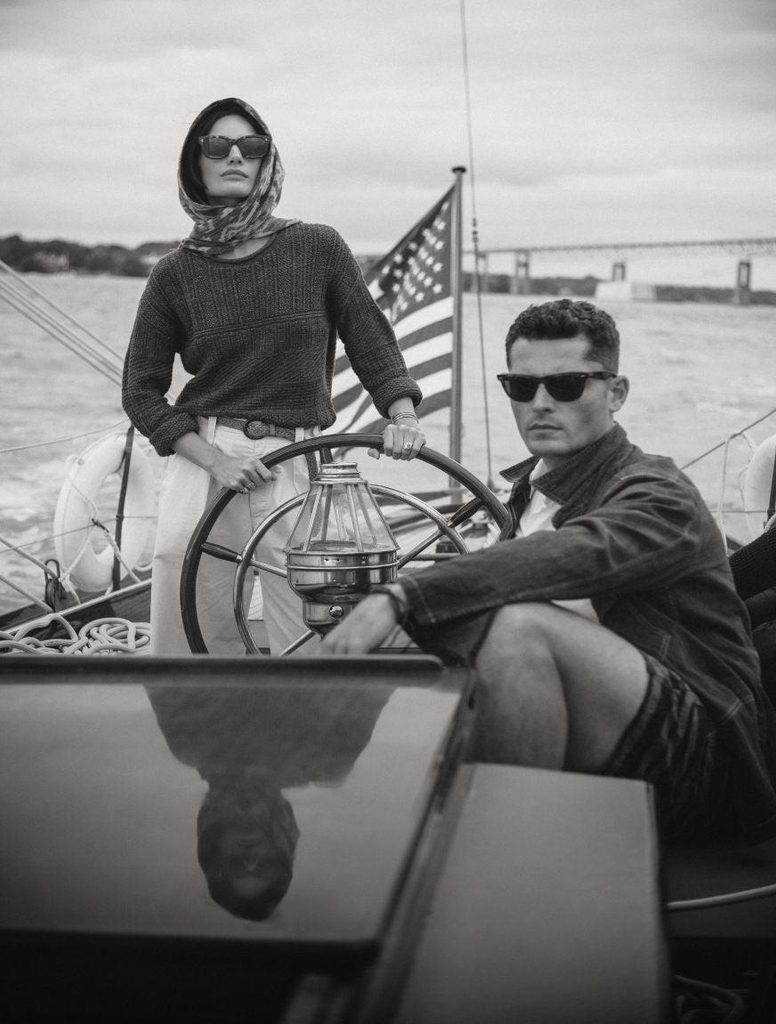
The sea, one of Ralph Lauren’s great mythologies.
The sea provides one of RL’s defining palettes: navy, white, ecru, red, yellow, sky blue, stripes, flags, pennants, washed cotton, sun-faded canvas, the bold colours of a regatta. Ralph Lauren took that palette and turned it into a wardrobe: stripes, pale chinos, white jumpers, parkas, caps and madras.
Stepping into a story
Ralph Lauren has never really designed clothes alone. He has built sets. He has written parts. He has chosen fabrics, colours, accessories, houses, cars, dogs, clubs, beaches and roads as a director chooses a location, a quality of light, a piece of music, an actor.
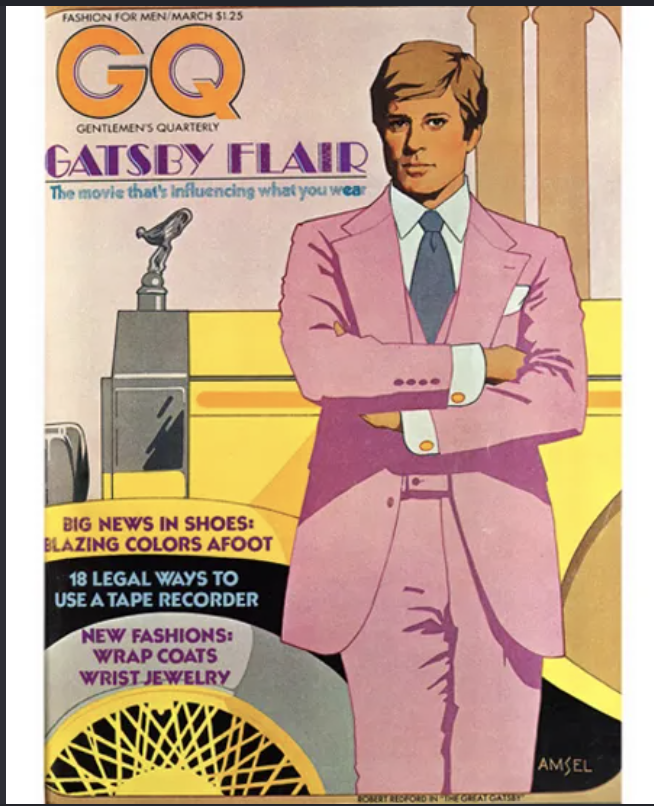
Gatsby on the cover of GQ: an entire world captured in a silhouette.
The horse and the sea are two engines of storytelling, two windows onto the world. Ralph Lauren has always loved blurring the line between dream and reality, and reality and dream.
Ralph Lauren has given us a cinema of the imagination. We can enter his house as a rider, a sailor, a motorist. We can change roles without betraying who we are.
Here was the life I wanted to lead, playing out before my eyes.
Perhaps that is Ralph Lauren’s true power: he invites us not simply to buy a garment, but to step into a story. He draws on our imaginations, our roots, our culture, our shared inheritance. And when that story works, it feels nothing like an advertisement. It feels like the memory of a life, of an era, that not all of us have known, yet all of us recognise.
Style and memory
Fashion is unquestionably born of artistic expression, sometimes spectacularly so. Fashion designers offer a vision of the world and have often helped to change it. For as long as fashion has existed, one silhouette has displaced another. Designers make and unmake trends. Some runway shows have felt more like contemporary art exhibitions than presentations of clothes intended to be worn. Season after season, the aesthetics of the moment are reinvented, with varying degrees of success.
Ralph Lauren is a major figure in the fashion industry, but his work unfolds on a different timescale: that of clothes and objects that outlast trends.
He makes the present out of memory. He finds inspiration in the everyday texture of our lives. People are his muse, and his clothes remain connected to a purpose, a trade, a place. Elbow patches on tweed jackets began as a way of reinforcing worn cloth. Function gave rise to beauty, and Ralph Lauren works with forms whose power comes precisely from having existed before him. From American workers, he borrows chore jackets, sturdy shirts and worn denim; from fishermen, oilskins, heavy knits and clothes made to withstand wind and salt. From cowboys come boots, Western shirts, fringed jackets and a bearing shaped less by design than by a way of life. At English and American universities, he finds the Oxford shirt, chinos, the blazer and college sweaters; among riders, tweed, boots and show jackets.
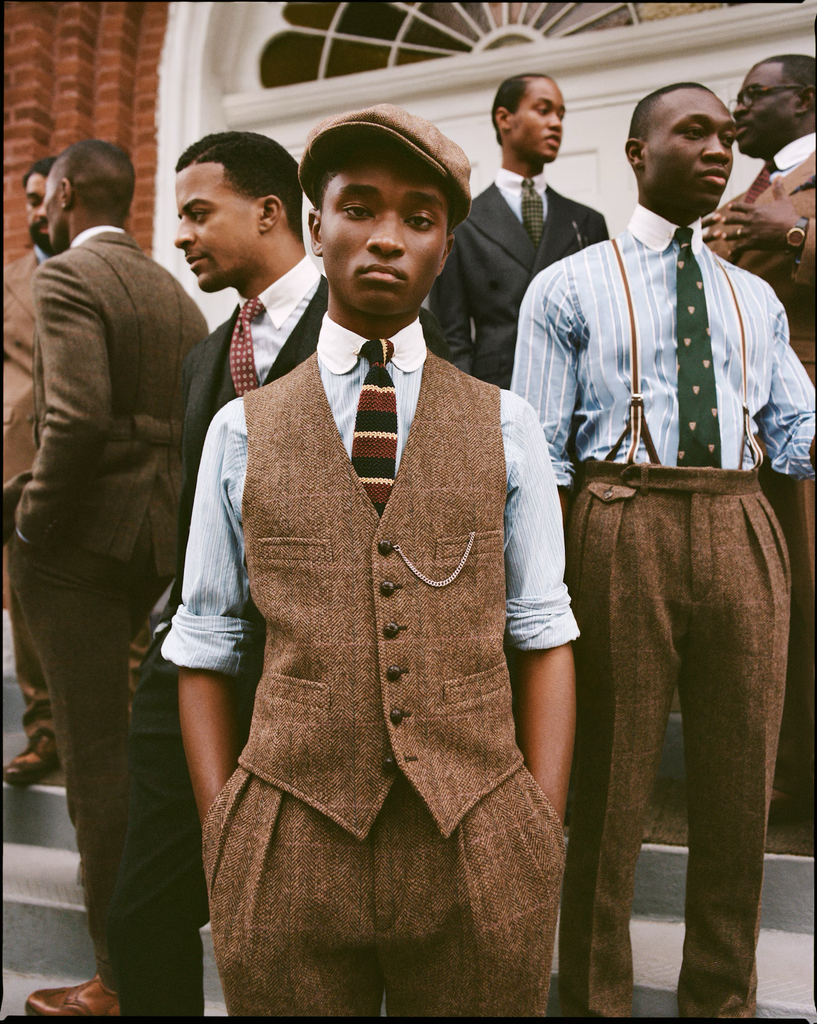
Morehouse: collegiate dress as a living inheritance.
His style does not fade; it takes its place in time. This is what he means by a sense of integrity.
For Ralph Lauren, novelty is not a virtue in itself. Many of the fabrics central to his world share a quality: they stand up to wear. Some become more beautiful as they crease, fade, acquire a patina or are repaired. Time leaves its signature.
A language anyone can make their own
By elevating everyday life, he has preserved its practical traditions and turned social codes into a shared vocabulary. In the late 1980s, Brooklyn’s Lo Lifes embraced Polo Ralph Lauren with an intensity that transformed the brand into a language of the streets and hip-hop. The paradox is striking: an imagined world of clubs, skiing, yachting, campuses and old America becomes the uniform of young, working-class Black Brooklyn.
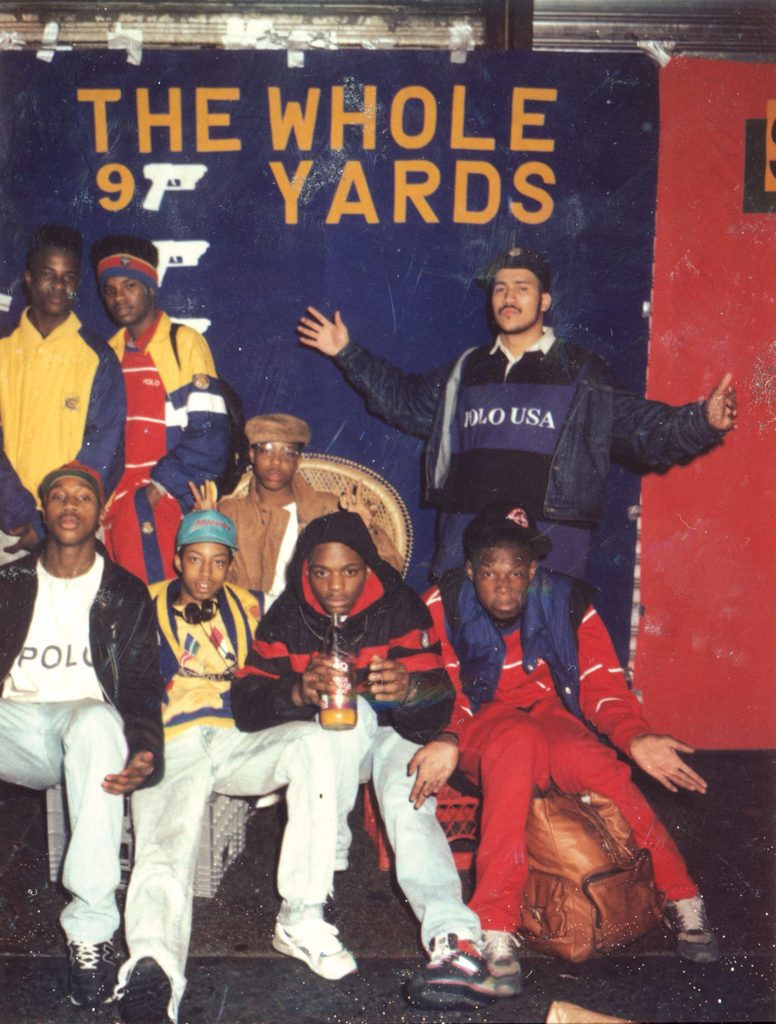
The Lo Lifes: Polo’s codes become a language of the streets.
Ralph Lauren did not inherit the world he depicts. He adopted it, studied it, dreamed it into being, then made it something that could be passed on. He understood that the symbols of an inheritance could become a common language.
Gen Z is now making the polo shirt, the Oxford, the blazer, heavy knits, tartan and the Polo Bear its own, mixing and wearing them on its own terms. With the “Ralph Lauren Christmas”, it has turned into a cultural phenomenon the Christmas of dark wood, tartans, dogs, fir trees and long tables crowded with family and friends that Ralph Lauren has been staging for decades. Generations come and go, combinations change, but the grammar endures. It seems to me that this generation recognises in his world something it is looking for today: permanence in an unstable world, substance in a digital one, history in a world saturated with novelty, and enough codes to reinterpret in its turn.
After years of microtrends manufactured and consumed at breakneck speed on social media, we are looking for bearings in a world that has become less certain: familiar signs, rituals, places and images that reassure us because they seem always to have existed. Ralph Lauren’s totems belong to that collective memory. And in daily lives saturated with screens, images and now artificial intelligence, he continues to offer a world that feels profoundly real, tactile, physical, lived in. Luxury itself is changing. Status alone is no longer enough: we look to brands for emotion, identity, a vision of ourselves. On that ground, Ralph Lauren has a fifty-year head start.
Ralph Lauren has always taken the long view, out of passion rather than strategy, perhaps even out of necessity. For nearly sixty years, he has celebrated a particular idea of the American dream, nourished by the European traditions he admires and the American mythologies he has made his own. When we dress in Ralph Lauren, we choose the stories we want to remain part of.
To step inside Ralph Lauren’s world is to return to what matters, to come home to family, to remember. For nearly sixty years, he has been telling the story of a world we needed to find again. Ralph Lauren has not come back into fashion. By never following it, he has allowed the times to catch up with him.


